
4000+
NETWORK PARTICIPANTS
NCQA
VALIDATED
3M
REAL-TIME ADTS PER MONTH
53M
LONGITUDINAL HEALTH RECORDS
Manifest MedEx provides the expertise public health leaders need to address the social drivers of health (SDOH) that impact 80% of wellbeing. We support counties in two vital ways: powering disease surveillance and population health for public health agencies, and facilitating the cross-sector coordination required for whole person care.
Effective population health management requires collaboration across all levels of care, supported by comprehensive data to identify trends, inform decisions, and enable timely interventions.
Advancing CalAIM and Public Health
Utilize social care data and tools through our MX Engage to coordinate the life-changing services that foster stability and health for those you serve.
Use MX Access to instantly view the health history of individuals who may not have their own records or don’t have a full picture of their health journey.
Use automated notifications (MX Notify) to intervene with testing, education, and outreach in moments that matter.
Get Limited Data Sets collected in near real-time for eight health domains across a geography to generate dashboards and analytics.
Access the most up-to-date contact information to locate and support those who’ve been lost to follow up.
Learn more from our info sheets: View County Solutions >
Real-World Impact
-
Manifest MedEx and California Mental Health Services Authority Partner to Provide Free Hospitalization Notices to California Counties
Collaboration will accelerate sharing of admit, discharge, and transfer notification data for behavioral health and advance whole person care [Riverside, Calif. – (BUSINESSWIRE) – December 16, 2025] Manifest MedEx (MX), California’s largest nonprofit health data network, announced a new initiative with California Mental Health Services Authority (CalMHSA) to support secure and appropriate data exchange between…
-
Findhelp and Manifest MedEx Announce Data-Sharing Partnership to Advance Integration of Social and Health Care Data Across California
Collaboration advances California’s Data Exchange Framework by connecting social drivers of health data with clinical records across the state.
-
Health-Related Social Services Organizations Joining Manifest MedEx Network
Among first to join is Illumination Health + Home, which offers integrated housing and healthcare services in Southern California Health-related social services (HRSS) organizations can now connect and exchange health and HRSS information through California nonprofit health data network Manifest MedEx (MX) to help those experiencing health-related social needs and support California Advancing and Innovating…
-
California Health Data Utility Manifest MedEx’s Increasing Role in Public Health
In 2022 MX began supporting the California Department of Public Health with the infrastructure required to enable statewide electronic lab reporting During a WEDI 2025 Spring Conference panel session, Erica Galvez, CEO of Manifest MedEx (MX), highlighted several ways the health data utility (HDU) is partnering with state and local public health agencies in California…




-
Healthcare IT Connect’s Public Health Modernization Day: “Modernizing Public Health Data Infrastructure with Health Data Utilities”
With opening remarks by Jennifer Layden, Director of the Office of Public Health Data, Science, Technology at the Centers for Disease Control and Prevetion (CDC), hear from Consortium for State and Regional Interoperability (CSRI) members as they share opportunities for HDUs to meet the state and federal public health needs of today and in the…
-
Building Public Health Data Infrastructure Is Key to Precision Public Health
Leveraging health information exchanges gives public health the functionality needed to modernize and flex to the ever-changing landscape of disease and need around us We are at an important crossroads for public health in this country. The COVID-19 pandemic has highlighted that our woefully underfunded public health infrastructures are in desperate need for modernization, starting…
-
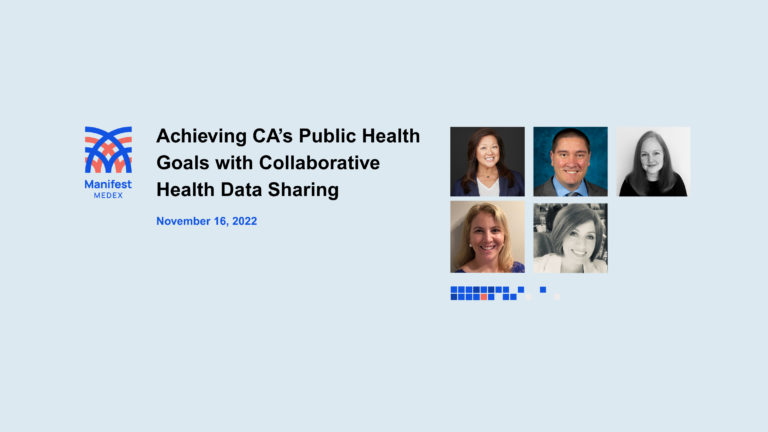
“Achieving CA’s Public Health Goals with Collaborative Health Data Sharing” Webinar Recap
California is currently facing a public health crisis around congenital syphilis (CS), yet CS is 100% preventable with timely intervention and treatment. Health Information Organizations (HIOs) are in a unique position to make data and tools available to local public health jurisdictions (LHJs) and public health communicable disease teams for timely prevention, intervention, and treatment….
-
Congenital Syphilis, Although 100% Preventable, Is a Health Crisis
The U.S. is currently facing a public health crisis — one that is on the rise at an alarming rate, has devastating consequences, and is 100% preventable. And that’s congenital syphilis (CS). Mothers with syphilis can transmit it to their babies during pregnancy or at birth. Approximately 40% of babies born to patients with untreated…
-
Data Sharing Can Reverse a Health Crisis
A deeper look at the congenital syphilis situation in San Bernardino County Congenital syphilis (CS), a preventable and potentially devastating disease passed during pregnancy, is increasing at an alarming pace in California and nationwide. If a pregnant mother diagnosed with syphilis does not receive timely treatment, the impact of CS on the baby can be severe, ranging…
-
Improving Public Health and Communicable Disease Control With Health Information Exchange
How the largest county in the U.S. launched an innovative prevention effort using ADT alerts and longitudinal patient records to coordinate care for vulnerable pregnant women The San Bernardino County Department of Public Health (SBCDPH) works in partnership with their communities to promote and improve health, wellness, safety, and quality of life in San Bernardino…
-
Health Plan of San Joaquin Drives California’s Mission to Vaccinate Vulnerable Populations
As California’s Covid-19 vaccination distribution began, a leading Medi-Cal health plan focused on innovation and strategy to support its highest-risk and underserved members Located in the heart of California’s multicultural Central Valley, Health Plan of San Joaquin (HPSJ) is the leading Medi-Cal managed care provider in the region, serving over 91 percent of Medi-Cal recipients…
-
Health equity in California must start with health data
This pandemic has amplified long-standing health inequities and exposed a fundamental truth: The information infrastructure of public health systems is severely under-resourced, outdated, and fragmented. Years of federal and state disinvestment have taken their toll on California. I’ve seen it through my decades of public health work in four California counties. Health inequities are driven…






California Roots. National Connectivity.
Ready to explore what’s possible with the state’s largest non-profit health data network?