

October Updates
Manifest MedEx Partners with County of Santa Cruz to Strengthen Cross-Department Coordination

In September, Manifest MedEx announced that the County of Santa Cruz is implementing MX’s social health information exchange (SHIE) platform, MX Engage. The effort will help county departments across health, social services, and public safety coordinate care and services through secure, consent-based access to shared information.
MX Engage was designed to be implemented by counties across California. The platform brings together social, behavioral, and clinical data into one easy-to-understand view of each person’s social care risks and needs. Authorized care teams can also use built-in tools, like intake forms, behavioral health screeners, and closed-loop referrals, to coordinate care directly without needing to track down records across separate systems.
The first use case to roll out as part of the multi-year Santa Cruz County program supports the Justice-Involved Reentry Initiative, which allows eligible Californians who are incarcerated to enroll in Medi-Cal and receive a targeted set of services in the 90 days before their release. Through MX Engage, Manifest MedEx will ultimately enable one coordinated release plan across Santa Cruz’s sheriff, probation, behavioral health, and housing departments. Authorized access to shared information supports pre-release assessments, screeners, referrals, and care plans for incarcerated individuals, with additional county teams and use cases to follow.
Read the full press release here.
Evolution CA: Bay Area Regional Forum Recap
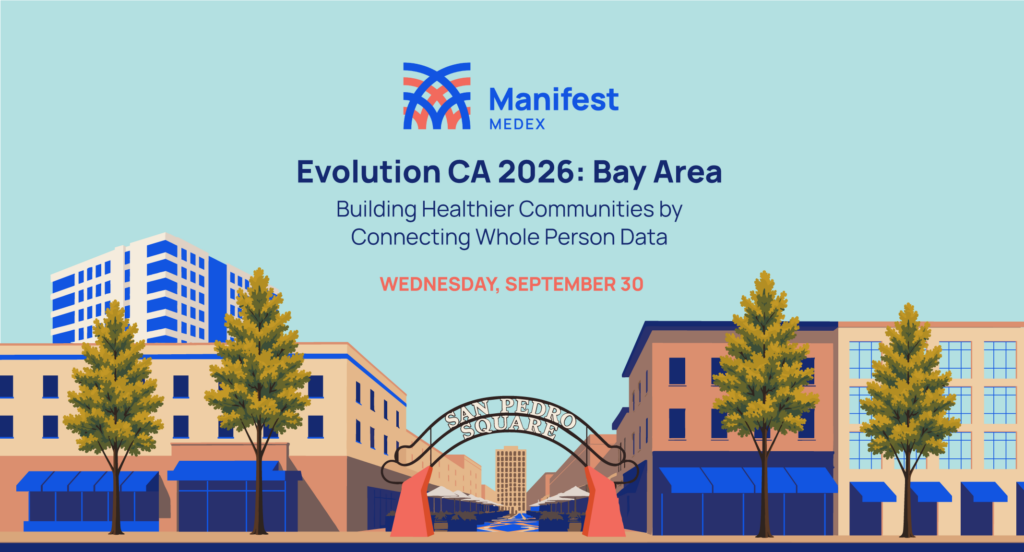
On September 30th, Manifest MedEx (MX) held its annual regional forum, Evolution CA 2026: Bay Area, themed “Building Healthier Communities by Connecting Whole Person Data,” in San Jose.
Leaders from counties, state agencies, health plans, hospitals, providers, and community-based organizations convened for a day of collaboration and conversation on recent policy developments, strategies for building county-wide data exchange ecosystems, and ways to put health data innovations to work for healthier Bay Area communities.
DHCS Director Michelle Baass opened the forum with a look at the 2026-27 Budget Act, the federal H.R. 1 changes affecting Medi-Cal, and a proposed $59.9M investment in real-time behavioral health and housing data exchange.

With federal funding shifting, CalAIM calling for deeper integration, and local resources tightening, we welcomed a panel of local industry leaders in Santa Cruz County who discussed breaking down traditional silos to connect clinical, behavioral, and social services.

We also heard from Fresno County’s Public Health Director, Joe Prado, who shared how Fresno County’s Information Exchange (FCIE) is partnering with MX to bring school districts directly into the health data ecosystem to support a pilot on youth suicide prevention, followed by MX’s Jason Buckner, who shared how MX is tackling some of the toughest challenges around advancing health data exchange, such as securely sharing permitted sensitive data and navigating consent for social health data.

After lunch, we heard from regional and state leaders on how high-resolution, whole person data has impacted behavioral health, health plans and providers, and community-based organizations.
Our closing keynote featured Assemblymember Mia Bonta, Chair of the Assembly Committee on Health, who highlighted SB 660’s role in strengthening the Data Exchange Framework while protecting sensitive data, outlined H.R. 1’s potential impact on Medi-Cal, and spotlighted whole person care in Santa Cruz, Fresno, and Alameda counties. She closed by emphasizing that AI in health care should support, not replace, human judgment.

We closed the event by presenting the 2026 MX Mosaic Award to Joe Prado, Director of the Fresno County Department of Public Health, for advancing healthier communities through innovation and collaboration in health data exchange.

We want to thank our speakers, sponsors, and attendees for making this event possible! Visit our website to read our full recap and check out more photos from the event!
New Enhancement to MX Access!
Beginning in November, Manifest MedEx is introducing two new tabs to the patient record in MX Access: SDOH (Social Drivers of Health) and Care Team. These tabs give social drivers a dedicated, visible home right alongside the clinical information you already rely on. Housing stability, food access, transportation, and social support all shape a patient’s health and their ability to follow a care plan, and seeing them in one place helps you identify needs earlier and make more informed decisions. The Care Team tab makes collaboration just as simple. Users can easily see the providers and supporting community partners to connect with them directly, reducing gaps in care.
Whether you’re reviewing a patient’s social history before a visit or reaching out to their care team, everything is just a click away, with search and sorting that work like every other tab in MX Access. For more information, please contact us at info@manifestmedex.org.
MX Monthly Product Trainings
Manifest MedEx hosts monthly product trainings to help users walk through key features designed to boost efficiency and enhance productivity in MX Access, MX Notify, and our MX Admin Settings.
Sign up for one of our trainings here to learn how you can get the most out of MX’s web portal. The next training will be held on November 13 at 12 pm PT.
If you have any questions, please do not hesitate to reach out to Cha Lee, Product Manager.
MX Welcomes New Participants!
Manifest MedEx welcomes Blue Zones Health, CareMore Health, and Easy Health to our ever-growing network!
Founded in 2008, Blue Zones Health is a primary care delivery and wellness organization that aims to treat the whole person—addressing diet, exercise, sleep, stress, and community—before resorting to medication and surgery. Manifest MedEx looks forward to serving as Blue Zones Health’s designated QHIO to help them achieve DSA compliance.
CareMore Health is an innovative healthcare delivery system that aims to provide comprehensive, compassionate, whole-person care for over 55,000 patients. Focused on trust and relationships that last, CareMore Health uses its team-based approach and highly specialized primary care providers to not only treat symptoms but also support overall well-being by addressing social drivers of health. Through this partnership, Manifest MedEx will provide ADT forwarding services to improve care coordination.
With over 700K members reached across 40+ states, Easy Health partners with health plans and provider groups to deliver proactive care. Manifest MedEx will provide ADT forwarding services to help Easy Health deliver holistic support across every stage of care and ensure their members receive timely, coordinated, and impactful interventions.
News & Events
ICYMI: The Consortium for State and Regional Interoperability (CSRI) Announces Completion of First Self-Assessments Using the Health Data Utility Capability Model
The Consortium for State and Regional Interoperability (CSRI), a collection of the nation’s largest and most robust nonprofit health data networks, and of which Manifest MedEx is a founding member, has announced completion of the first member self-assessments using the Health Data Utility (HDU) Capability Model. One year after CSRI launched the model at the Civitas Networks for Health 2025 Annual Conference, all six CSRI members scored themselves against the model’s 175 capabilities across five stakeholder domains – public health, payers, providers, researchers, and patients.
The process surfaced several scoring and definition gaps in the model. Those findings, together with input from a new peer cohort that CSRI is launching alongside this announcement, will help shape the next version of the model. Members also found value in the exercise itself, from prompting closer internal review of their own capabilities, to identifying a clear next priority, to separating true technology gaps from market or policy constraints.
CSRI is also launching the Capability Model Learning Community, a national founding cohort of more than 40 HIEs completing the self-assessment with support from CSRI and Civitas Networks for Health. Participants get expert scoring and review, access to aggregate benchmarking data, and peer collaboration through mid-November, with recognition as an inaugural participant.
Read the full press release here.
Network Growth
New data sources available on MX this month:
ADTs from the following 4 participants:
Center for Inherited Blood Disorders
Community Hospital of the Monterey Peninsula (3 locations)
Pediatric Medical Group of Santa Maria, Inc.
Peninsula Healthcare Connection
CCDAs from the following 10 participants:
Bristol McFadden Medical Group
Cajon Medical Group, Inc. (16 locations)
Center for Inherited Blood Disorders
Compass Health, Inc. (6 locations)
Lakeport County Fire Protection District
Onestop Medical Center (2 locations)
Pediatric Medical Group of Santa Maria, Inc.
Peninsula Healthcare Connection
Primary Care Medical Group of Inland Empire, Inc.
VersaCare Emergency Medical Services, Inc.
Labs from the following 4 participants:
Families Together Of Orange County (4 locations)
JT Family Care (2 locations)
Karing Pediatrics Medical Group
Tenet Healthcare (4 locations)
Observational Results from the following participant:
El Centro Regional Medical Center (9 locations)
Have questions or want to learn more? We’re here to help. Reach out.
We want to hear from you! Let us know how we’re doing.