

August Updates
ICYMI: Manifest MedEx 2025 Annual Report
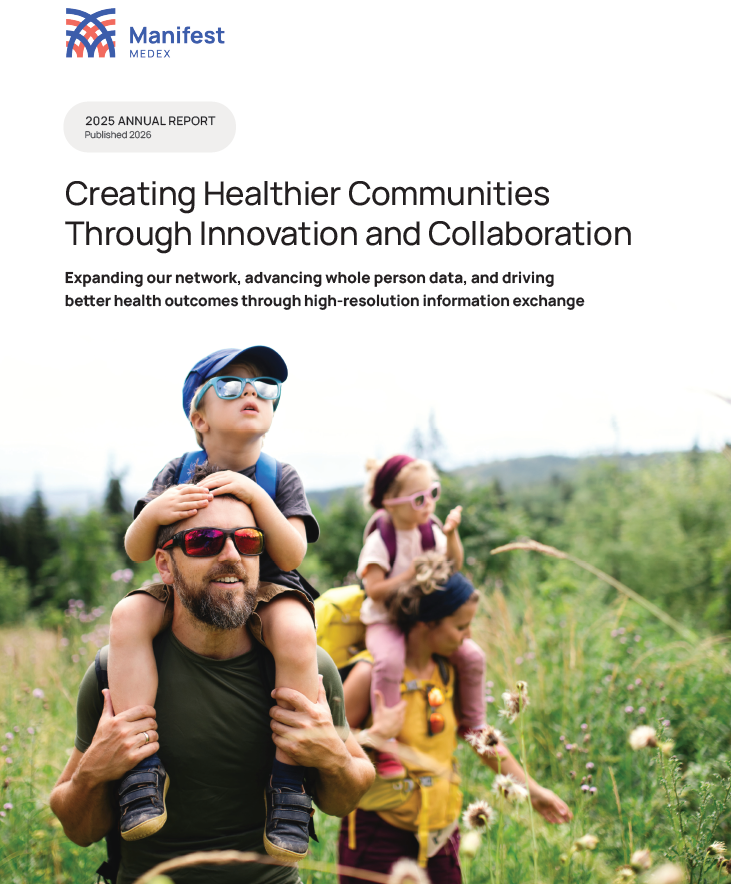
Manifest MedEx published the 2025 Annual Report last month. This report lays the groundwork for our work to achieve our new mission and 2035 vision, showing how we are turning timely, relevant, hard-to-reach data into a more complete view of each person’s health journey and leading the shift in data exchange from reliable to genuinely useful.
In 2025, Manifest MedEx reached a new milestone, with health and social care data for more than 50M individual records. Our network grew 12% as we welcomed new providers, agencies, skilled nursing facilities, health plans, hospitals, and health systems.
Through partnerships with community care network platforms, the California Mental Health Services Authority (CalMHSA), and the Serving Communities Health Information Organization (SCHIO), Manifest MedEx is helping accelerate the secure, permitted exchange of clinical, behavioral, and social care information across California.
Read our report here.
Evolution CA: Bay Area Regional Forum
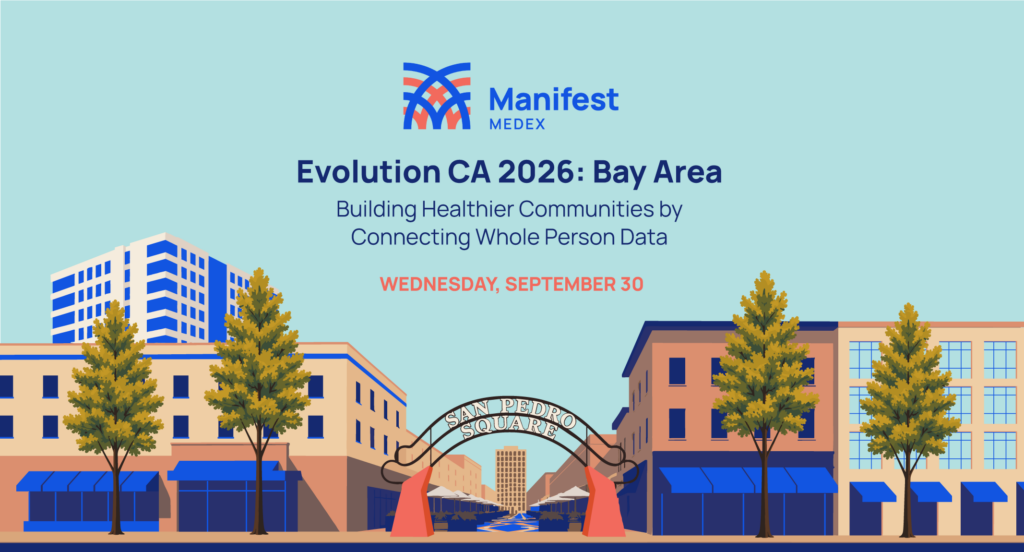
Manifest MedEx is hosting a one-day regional forum on September 30 in San Jose, focused on collaboration, innovation, and creative problem-solving as we bring together stakeholders from the Bay Area and nearby communities to discuss how whole person data exchange can support healthier communities and ensure people receive timely care informed by all aspects of their health.
Hear from state, regional, and local experts as they provide real-world use cases that highlight opportunities for collaboration between health care, behavioral health, and social care organizations to support whole person care. Here are just a few topics we’ll be covering, with more to come as we finalize our agenda:
- Michelle Baass, Director, California Department of Health Care Services (opening keynote), on the state’s multi-billion-dollar budget strategy and how the department plans to safeguard care for over 14 million Medi-Cal members to build a leaner, more resilient health ecosystem.
- Joe Prado, Director, Fresno County Department of Public Health, on Fresno’s groundbreaking Youth Suicide Prevention program that bridges policy, real-time ADT notifications, school-level participation, and parent and student engagement into a responsive, community-wide safety net.
- Jessica Randolph, Director of Administrative Services, Santa Cruz County Health Services Agency, Dr. Mike Wang, Chief Medical Officer and Chief Health Equity Officer, Central California Alliance for Health, and Darlene Torres Voss, Director of Community Health Services, Salud Para La Gente, on how they’re breaking down silos and connecting whole person data to transform care in Santa Cruz County.
- Dr. Amie Miller, Executive Director, California Mental Health Services Authority, and Kristin Azar, Vice President of Quality and Performance Excellence, Institute for Aging, will share real-world use cases that demonstrate how meaningful data sharing is translating into better coordination, faster interventions, and stronger outcomes
- Assembly Member Mia Bonta (18th Assembly District), Chair of the California State Assembly Health Committee (closing keynote), reflects on the Health Committee’s 2026 legislative work on data sharing, coverage, and AI in healthcare, and looks ahead to what’s possible under a new Administration.
You won’t want to miss this day of collaboration, innovation, and serious fun (!), hosted by Manifest MedEx. If you are interested in attending our regional forum, please contact us at info@manifestmedex.org.
Improve Your Data Quality with Manifest MedEx
Health care providers, hospitals, and health plans need as complete a picture as possible of a person’s health and health history to close care gaps, improve quality performance, support care coordination, and inform clinical decisions. However, health data is often fragmented across systems, providers, and facilities, and frequently arrives with inconsistent terminology, local codes, non-standard codes, or uncoded free text.
To improve data quality, MX enhances—or “uplifts”—data by identifying local codes, codes formatted incorrectly, or missing coding systems and mapping them to industry-standard code systems across ten domains: Allergy, Diagnosis, Ethnicity, Immunization, Labs, Medication, Problem/Conditions, Procedure, Race, Vital Signs.
Enhanced data is available for our Longitudinal Patient Summaries (LPS) by normalizing and standardizing clinical codes before incorporating them into the longitudinal patient summary, and for our NCQA Data Aggregator Validation Services by improving the accuracy of patient/member data used in HEDIS measure calculations. In a sample of approximately one million CCDAs within the MX network for which code normalization was applied, MX achieved an enhanced rate of 83.2% through our enhanced Longitudinal Patient Summaries and 48.8% through our enhanced NCQA Data Aggregator Validation Services.
Read more about these services and contact your Regional Executive Director to get started.
MX Monthly Product Trainings
Manifest MedEx hosts monthly product trainings to help users walk through key features designed to boost efficiency and enhance productivity in MX Access, MX Notify, and our MX Admin Settings.
Sign up for one of our trainings here to learn how you can get the most out of MX’s web portal. The next training will be held on September 11 at 12 pm PT.
If you have any questions, please do not hesitate to reach out to Cha Lee, Product Manager.
MX Welcomes a New Participant

Manifest MedEx welcomes Carelon Behavioral Health to our ever-growing network!
With over 150,000 network providers and serving over 61 million members across all 50 states, Carelon Behavioral Health works to improve the health and well-being of individuals coping with mental health and substance use conditions by focusing on whole-person care, recovery, and helping everyone live their lives to their fullest potential. Manifest MedEx looks forward to providing Carelon Behavioral Health with access to comprehensive longitudinal health records so their teams can make better-informed care decisions for their target member populations.
News & Events
Beyond the Badge: Data Quality in the Age of Continuous Validation
When NCQA validated its first ten clinical data streams in late 2021, Data Aggregator Validation looked like an experiment. Four years on, it looks like infrastructure. The program’s eleventh cohort opened in January 2026, and NCQA reports that fifty organizations across twenty-one states have now completed more than 130 validations. For health information exchanges (HIEs), a validated data stream has become something close to a credential of legitimacy. This is proof to health plans that the clinical data flowing out the door can be trusted for HEDIS reporting without redundant and costly work to prove data integrity all the way back to the source electronic health records at hospitals and doctors’ offices.
Read the full article published by HealthIT Answers.
Network Growth
New data sources available on MX this month:
ADTs from the following 2 participants:
Plazita Medical Clinic, Inc.
Tenet Healthcare (4 locations)
CCDAs from the following 2 participants:
Dub Health, P.C.
Namita Mohideen, M.D., Inc. (3 locations)
Labs from the following 2 participants:
Anaheim Community Hospital
Fresno Surgical Hospital
Have questions or want to learn more? We’re here to help. Reach out.
We want to hear from you! Let us know how we’re doing.